

Innovative tools to fight grapevine diseases
The VitiSense project aims to develop new tools for the early detection of grapevine trunk diseases, in order to support winegrowers in monitoring the health of their vineyards. Led by the University of Strasbourg under the Interreg Upper Rhine programme, the project seeks to improve vineyard monitoring through innovative technologies that can identify diseases before visible symptoms appear.
Grapevine trunk diseases: a challenge for vineyards
Grapevine trunk diseases are today a major challenge for viticulture in the Upper Rhine region. They are caused by fungi that gradually colonise the vines and often progress silently over several years. By the time the first signs appear on the foliage or the wood, it is often too late: yields decline, vines die back and some plots have to be replanted.
To this day, diagnosis relies mainly on visual observation, which offers limited means of anticipating the development of these diseases.
Developing new detection tools
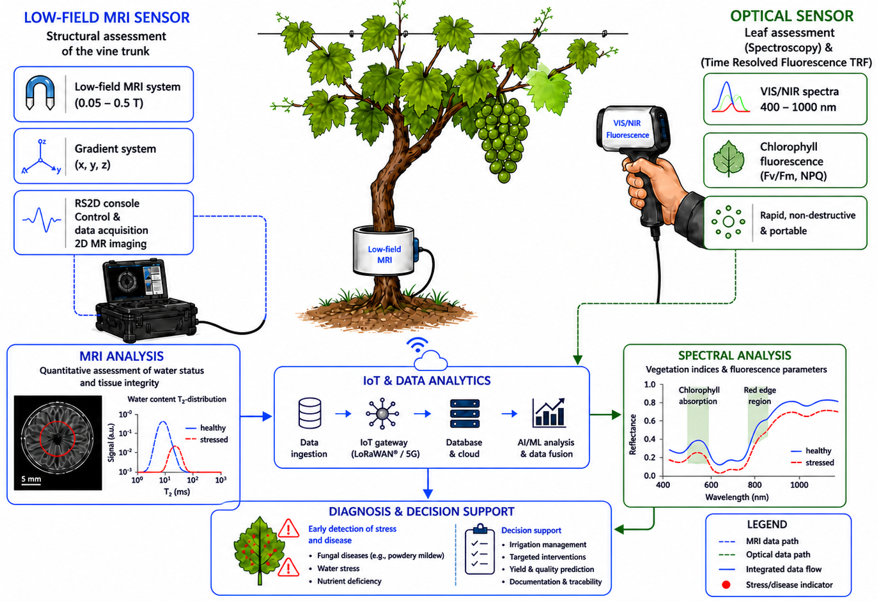
The project is based on the development of two innovative devices:
- A portable MRI imager, mounted directly on the vine trunk in a simple and non-invasive way. It will make it possible to look inside the vines and detect at an early stage the presence of fungi, necrosis or rot responsible for vine decline.
- A portable optical sensor dedicated to photosynthesis analysis, developed specifically for grapevine leaves. It will detect very early signs of physiological stress that reveal the onset of disease before symptoms appear.
Towards precision viticulture
Ultimately, these two technologies can be used independently or integrated into a connected network of sensors distributed across the plots. This approach paves the way for precision viticulture, able to monitor vine health continuously and to enable more targeted interventions.
The expected benefits are manifold:
- improving vineyard health;
- reducing losses caused by vine decline;
- promoting more sustainable management of wine estates;
- helping to preserve the winegrowing heritage of the Upper Rhine region.
Timeline and funding
The VitiSense project runs for 36 months, from 1 January 2026 to 31 December 2028. Its total budget is nearly one million euros, of which around €500,000 is funded by the European Regional Development Fund (ERDF) under the Interreg Upper Rhine programme.
This project is co-funded by the European Union.
Partners
Led by the University of Strasbourg, the project brings together academic, scientific, institutional and industrial partners from the Upper Rhine region.
Discover our partners